


IN BRIEF: In a 6-3 decision on April 29, the United States Supreme Court struck down Louisiana’s congressional map and effectively eliminated one of the most powerful tools designed to protect voters from discriminatory voting systems — Section 2 of the Voting Rights Act (VRA). Section 2 is the portion of the VRA that traditionally prohibits voting practices or procedures that discriminate based on race.
Because of the ruling in this case, Louisiana v. Callais, federal protections against racist voting maps are essentially gone in all but name. By ruling the map unconstitutional and gutting Section 2, the court has given state legislatures the green light to use partisan gerrymandering as a wholesale excuse to deny Black voters a voice in their government. The decision affects not only congressional maps but legal challenges to discriminatory state legislative and local election systems, too.
The VRA had long been hailed as the crown jewel of the Civil Rights Movement, a safeguard for voters who fought and even died for protections against discrimination in voting. But the Supreme Court’s decision has undone the outcome of decades of sacrifices with the stroke of a pen.
This shameful ruling encroaches on Congress’ authority to enact laws that address racial discrimination, like the Voting Rights Act and its subsequent amendments with bipartisan support over the years. Moreover, with the newly eviscerated Section 2, voters looking to challenge racially discriminatory maps or other voting laws will face much higher legal barriers, all while covered by far fewer protections in court.
WHY IT MATTERS: This decision puts the very idea of a multiracial democracy at risk, and is massive loss for anyone who values a representative democracy that reflects the diversity that makes this country strong.
This devastating blow is not limited to Louisiana; states across the country will see fair districts vanish as legislatures aim to eliminate districts where Black voters have the opportunity to elect candidates of their choice to federal, state, and local offices. And now, these legislatures can create discriminatory maps with fewer, if any, checkpoints from the courts.
According to a recent report, 19 congressional districts that currently serve as opportunity districts for Black voters and other voters of color to elect candidates of their choice risk being redrawn in the aftermath of Callais. As for state legislative districts, 127 Black-majority districts now face elimination due to the ruling.
Plainly, the court’s decision threatens to divide our nation further and entrench power in the hands of the few. Multiple states, including Alabama, Mississippi, Tennessee, South Carolina, and Georgia, have already had state officials call for special legislative sessions with the express purpose of redistricting now that the Callais decision gives them free rein to redraw maps with discriminatory effects on Black voters.
In fact, in Louisiana, the governor has already moved to suspend elections for the House of Representatives, even though absentee ballots were already mailed to voters statewide. With early voting beginning on May 2, this is an extreme attempt to weaponize the Callais ruling to manipulate elections.
And Florida already passed a new map. In the hours immediately after the decision was released, the Florida legislature passed a map that aims to silence Black voters and other voters of color in the political process.
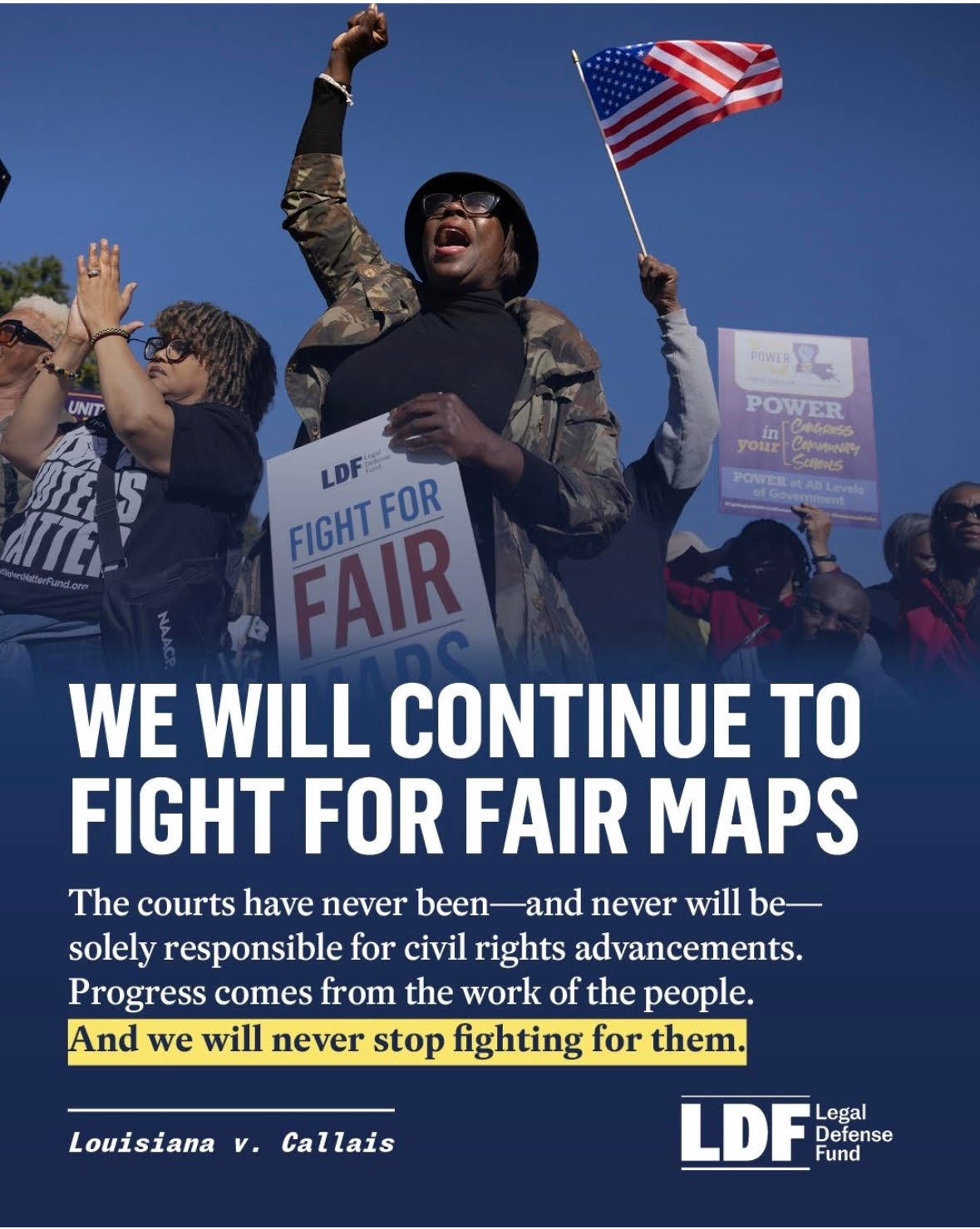
“The Supreme Court has reversed decades of progress toward a multiracial democracy in the name of partisan politics. The 6-3 majority decision is the height of hypocrisy and exemplifies the court’s waning credibility on matters of civil rights and racial justice. The ruling is devastating for Black Louisiana voters and for fair representation for all voters of color,” said Janai Nelson, President and Director-Counsel of the Legal Defense Fund in a statement issued on the day of the decision. “It also undermines the legitimacy of institutions that rely on fair maps to represent the American people. This is a day of shame for the Supreme Court. The majority’s claim that it is preserving our most sacred voting protections is disingenuous. It has rendered key voting protections that have served this country for more than 60 years null and void.”
Nelson continued, “This is a setback for our country and our Constitution, which grants Congress the authority to address the scourge of racial discrimination in voting. We will demand new legislation to protect voters and continue to fight to defend and advance civil rights for all people and to protect our democracy as our institutions continue to fail us. This fight will continue in the courts, in statehouses, in the streets, and, most importantly, at the ballot box until the promise of our multiracial democracy is realized. What the Court did not do and cannot do is take away our fundamental right to vote, and it is incumbent on every American to exercise that right now more than ever in service of our democracy.”
ON THE HORIZON: Justice delayed is not justice denied. The work to protect and advance Black people’s voting rights will be more challenging in the wake of this decision, but the Legal Defense Fund was built for this moment. Democracy will not fall on our watch.
Our fight for fair representation for our clients and voters of color nationwide continues. We must bring the fight to the legislatures. As local, state, and federal legislators continue to push unfair maps, communities must make their representatives hear them. They must push for broader, bolder voting rights protections. States must enact State Voting Rights Acts, and Congress must pass the John Lewis Voting Rights Advancement Act and the Freedom to Vote Act. To see change, people must put constant pressure on elected officials to create a fair and representative electoral system.
We must also bring the fight to the courts and demand that courts’ rulings reflect the promise of our laws, the principles of our Constitution, and our vision of a multiracial democracy. And we must bring the fight to the ballot box. Everyone must be prepared to vote in the primaries and in November. It’s our responsibility to ensure that communities feel the urgency to exercise their power and make their voices heard. Ensure you are registered, check that you have the required materials to vote by mail or in person, and create a voting plan with your friends and family to show up at the polls.
In the words of Justice Thurgood Marshall, “This is your democracy. Make it. Protect it. Pass it on.”
The fight has only just begun.
For more information on the timeline of Louisiana v. Callais, visit here.
