


IN BRIEF: On June 2, the U.S. Supreme Court issued a stay in the ongoing redistricting case, Milligan v. Allen, that allows Alabama to use a congressional map drawn in 2023 that deliberately dilutes Black voters’ political power.
This case has been a long and winding road for Black voters. Here’s how we got here:
In 2023, the Supreme Court found that Alabama’s 2021 congressional map discriminated against Black voters, violating Section 2 of the Voting Rights Act. In its decision, the court ordered Alabama to enact a new congressional plan with two districts in which Black voters would have the opportunity to elect the candidates of their choice.
Unfortunately, instead of enacting this plan, Alabama’s legislature doubled down on discrimination. In the summer of 2023, Alabama passed a new map that still contained only one opportunity district for Black voters, and reconfigured the second congressional district to have a Black voting-age population of only about 40%. In this revised district, Black-preferred candidates still lost every single election. In 2025, a unanimous three-judge court found that the 2023 map violated the U.S. Constitution and the Voting Rights Act.
Alabama was not subtle about its race-based purpose in drawing the map. In fact, Alabama politicians and lawyers overtly admitted their intent to defy the Supreme Court’s order. The 2023 legislature published justifications for its refusal to draw a new opportunity district based on a desire to protect the “French and Spanish colonial heritage” of the predominantly white people in Baldwin and Mobile Counties. These decisions openly prioritized keeping these two white counties together over protecting the right to vote.
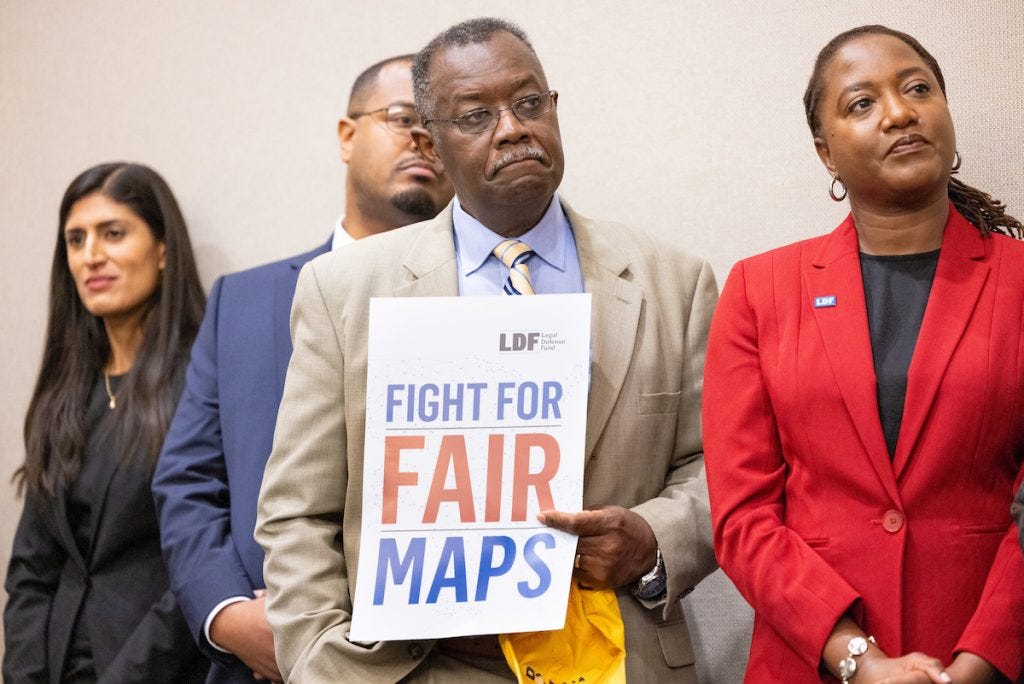
In April 2026, the Supreme Court issued its ruling in Louisiana v. Callais, which changed how Section 2 applies to redistricting cases. When the Callais decision was released, the Supreme Court sent the Milligan case back to the district court, asking it to reevaluate the case in light of Callais. In doing so, the district court again found that Alabama’s 2023 map had intentionally discriminated against Black voters and violated Section 2 of the Voting Rights Act, even under the new Callais standard. The district court ordered Alabama to use a race-neutral map for the 2026 elections. An independent court-appointed expert drew this map. It provides two opportunity districts for Black voters and was the same map used in the 2024 elections.
The stay issued last week by the Supreme Court suspends the district court’s order. That in turn allowed Alabama to reinstate the 2023 discriminatory map for the midterm elections.
WHY IT MATTERS: The right to vote, and be fairly represented in government, is the bedrock of American democracy. It’s the right from which all other rights flow.
Denying Black voters a fair shot at electing representatives of their choice relegates Black people back to the days of second-class citizenship by silencing their voices and denying them a place in the democracy that was built on the backs of their own ancestors.
“The Supreme Court’s decision gives cover to Alabama and others to deliberately and openly discriminate against Black voters without fear of any consequence,” said Deuel Ross, Director of Litigation at the Legal Defense Fund, in a press release issued after the stay was granted. “The court’s shameless decision to reinstate a racially discriminatory map defies any thoughtful or consistent application of the law. We will continue to throw all of our resources into the fight to ensure that Alabama voters have the fair representation that they deserve in Congress.”
Fair representation can lead to real change in communities. Fair maps can mean better schools, expanded access to health care, improved veterans’ services, lower grocery prices, increased economic opportunities, fair housing development, and so much more.
ON THE HORIZON: Alabama congressional elections — including a rescheduled primary on August 11 for congressional districts 1, 2, 6, and 7 — will now continue with the 2023 map.
The fight in the courts over Alabama’s congressional map will continue. The case remains on appeal in the Supreme Court. And the district court has set the case for retrial no later than January 2027.
There are also other avenues for creating fair voting practices in Alabama. The Alabama Voting Rights Act — state-level legislation that would restore and protect crucial voting safeguards for Black voters — was introduced this past spring and passed out of the Alabama House Judiciary Committee in early April.
And of course, there is power in collectively raising our voices to demand accountability from public officials.
It’s more important than ever that Alabama voters turn out at the polls to make their voices heard. Even when opponents of a free and fair multiracial democracy attempt to silence Black voices, overwhelming turnout builds political power one election at a time.
Make sure you’re registered to vote. Create a voting plan with friends and family. Find your polling place. Know what forms of ID are required at the polls in your state. Vote early, if you’re able. And research what’s on your ballot. There are local, state, and federal elections happening across the country.
