


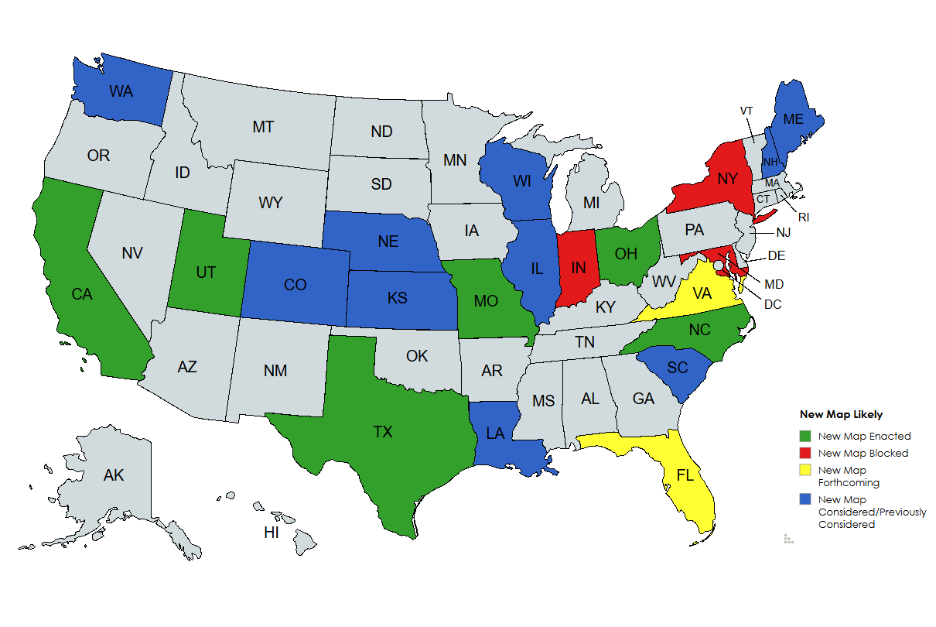
Welcome back to Redistricting Watch, where we break down exactly what’s happening inside statehouses across the country as state legislators redraw electoral districts and work to consolidate power outside of the normal redistricting cycle.
Missed our last issue? Here’s a quick catch-up.
Redistricting is the process by which state legislatures or other redistricting bodies redraw the boundaries of electoral districts. Redistricting typically coincides with the release of the U.S. census results, which occurs every 10 years at the beginning of each decade. But, right now, some state legislatures are redrawing congressional maps mid-decade — an unusual occurrence. This is called off-cycle redistricting, and it is not normal.
What’s troubling about the off-cycle redistricting happening right now is that legislators are sometimes using the pretext of partisanship to lock in power at the expense of Black voters and other voters of color, which the Constitution forbids.
Politicians should not be selecting voters. Voters should choose politicians.
Rules about how voting maps are drawn can impact every part of your life. When courts rule in favor of fair maps, fair access and representation become the standard. Fair maps mean having a say in lower prices at the store, better schools, safer streets, accessible health care, and so much more.
LDF is closely tracking additional redistricting developments as legislatures draw, defend, and enact new maps that will affect Black communities in countless ways. Below are state-by-state redistricting updates that have occurred since our last issue of Redistricting Watch was published on Jan. 30.
Maryland: NEW MAP UNLIKELY TO PASS
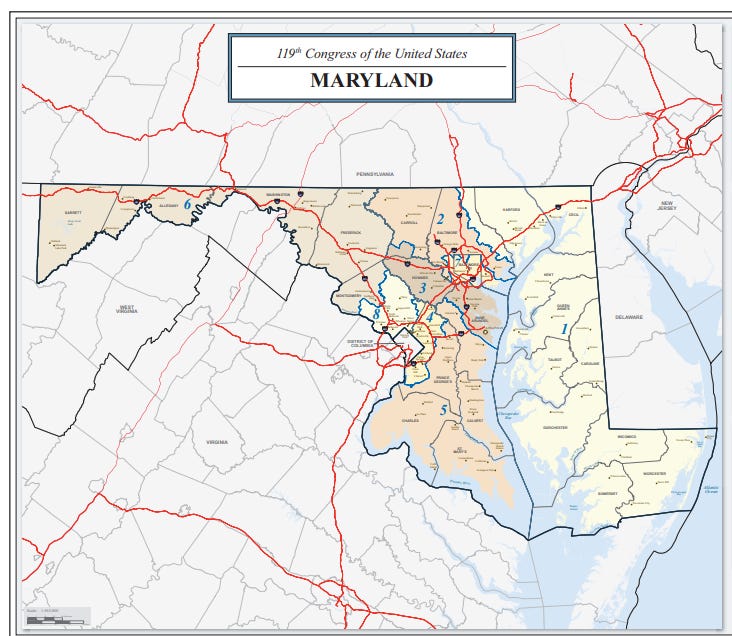
With time running out on Maryland’s legislative season, it’s unlikely that the Maryland redistricting proposal will move forward in time to go into place for the 2026 elections. The Maryland House passed the redistricting bill, but it has now stalled in the state senate.
Maryland Governor Wes Moore originally launched a redistricting commission in the fall of 2025 to explore drafting new congressional maps. The commission voted in favor of recommending new congressional maps, which led to a redistricting bill being introduced in the state legislature.
A recent poll by the Institute of Politics at the University of Maryland, Baltimore County, found that 81% of Marylanders polled are not in favor of redistricting for partisan gain.
Maryland’s current map has eight congressional districts.
Black voters make up 33% of all eligible voters in Maryland.
Virginia: NEW MAP BEFORE VOTERS AMID LEGAL CHALLENGE
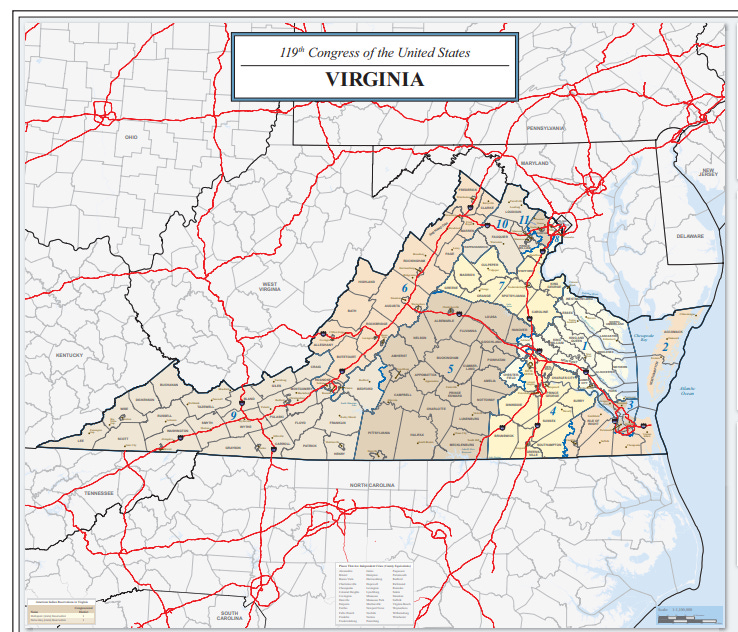
The Supreme Court of Virginia is currently reviewing the legality of the new congressional map proposal that passed out of the Virginia legislature earlier this year. However, the Court affirmed that the new map can still go before the voters as planned this spring.
Early voting on the new map began last week and will end with a special election on April 21.
A Virginia state court previously ruled that the Virginia legislature did not follow the proper procedure to allow the redistricting process to move forward when it voted to approve a state constitutional amendment on redistricting. Democratic lawmakers appealed the decision in hopes of blocking the ruling, and the State Supreme Court allowed the special election to proceed.
A recent poll suggests that 51% of Virginians support current redistricting efforts.
Lawmakers have expressed interest in flipping two to three of the state’s congressional districts.
Virginia’s current map has 11 congressional districts.
Over 1.7 million Black people reside in Virginia, making up 20% of the population.
Florida: NEW MAP FORTHCOMING
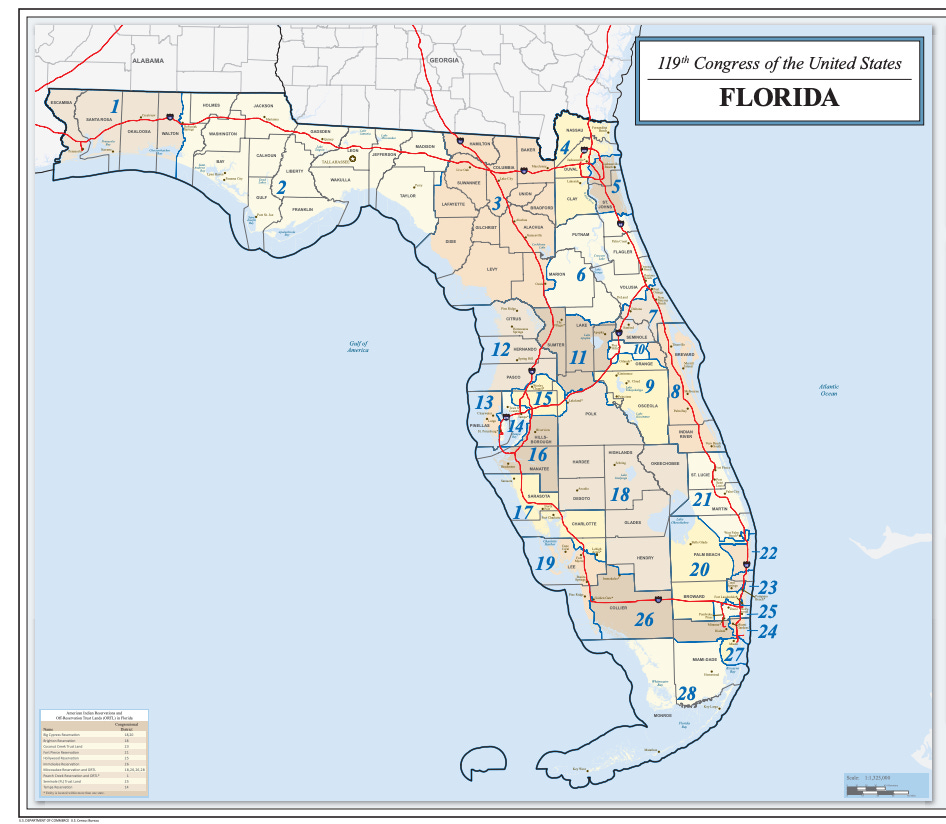
Ahead of a special legislative session called by Florida’s governor for April 20-April 24 to consider redistricting, the Florida Supreme Court unanimously rejected a petition to block the special session.
Florida’s leadership previously expressed a preference to delay the redistricting conversation until a Supreme Court ruling is issued in Louisiana v. Callais, which could affect key portions of the Voting Rights Act. However, a ruling has yet to be issued.
The Florida Constitution explicitly prohibits lawmakers from redrawing maps with expressly partisan aims.
Florida’s current map has 28 congressional districts
Over 1.7 million Black voters reside in Florida.
New York: NEW MAP TEMPORARILY BLOCKED
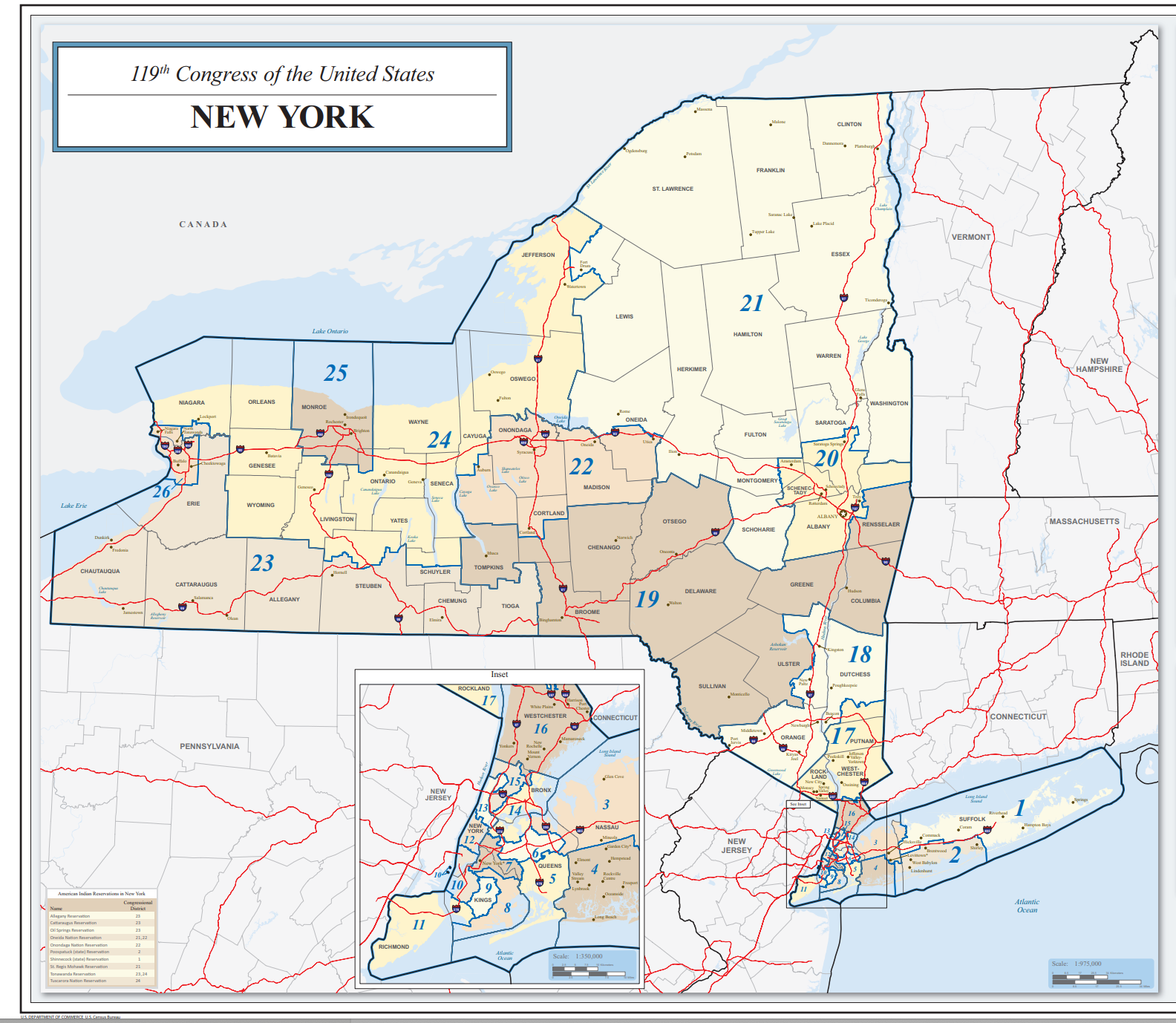
On Jan. 21, a trial court in New York ruled that the state’s congressional map, specifically the 11th congressional district, dilutes the voting power of Black and Latino voters. However, the U.S. Supreme Court recently intervened in the process, blocking the redistricting process until the case proceeds through the New York appeals courts.
This decision to block the redistricting process is at odds with the Court’s prior decisions in Texas and California allowing new maps to stand.
Before the Supreme Court intervened, the previous court order directed the New York Independent Redistricting Commission to redraw the district boundaries by Feb. 6. Republican officials appealed this decision on Jan. 26.
New York’s current map has 26 congressional districts.
Over 2.4 million eligible Black voters reside in New York.
Keep an Eye On:
In MISSOURI, a circuit court recently ruled that the state’s newly redistricted congressional map can stand after a lawsuit alleged that the map diluted Black voters’ political power. However, it’s still not a guarantee that the map will be used for the 2026 midterms, as additional lawsuits are currently moving through the Missouri Supreme Court.
In SOUTH CAROLINA, a redistricting plan was introduced in the legislature that appears to target the state’s sole historically Black district, represented by long-serving Congressman James Clyburn. The bill was debated at a House hearing, but has not moved forward.
In WISCONSIN, two redistricting lawsuits are currently playing out in court that could affect the state’s congressional map. Both cases are before three-judge panels. While it’s likely that these cases will go to trial in 2026, it’s unclear whether rulings will be issued and enacted in time for the 2026 midterms. Additionally, Wisconsin’s governor recently called for a special legislative session to ban partisan gerrymandering, something which faces significant opposition in the current Wisconsin legislature.
In UTAH, Republican officials are making their latest move in their attempts to undermine the fair map instated by a district court judge, after she had ruled that the state’s previous map illegally overrode an independent redistricting commission. 85% of registered Utah voters support an independent redistricting commission. However, on March 9, officials passed a measure on the last day of the legislature’s calendar that will clear the way for a ballot initiative to legalize partisan gerrymanders in the state.
In COLORADO, state officials and, most recently, a sitting U.S. Senator, have increasingly spoken out about the possibility of redistricting. While it’s almost certain the legislature will not redraw map lines ahead of the 2026 midterm elections, multiple Colorado organizations have been fundraising and organizing to put a ballot initiative before Colorado voters that would allow them to bypass the state’s redistricting commission and let the legislature draw a new map for the 2028elections.
Previous Updates
All states featured here are those that have had redistricting updates since our last issue of Redistricting Watch published on Jan. 30. For information from previous issues, please check out Redistricting Watch 1.0, Redistricting Watch 2.0, Redistricting Watch 3.0, Redistricting Watch 4.0, Redistricting Watch 5.0, and Redistricting Watch 6.0.
On the Horizon
LDF will continue to track updates as other states inch closer to initiating explicit redistricting efforts. Lawmakers are discussing holding special legislative sessions to determine the future of their congressional maps or proposing redistricting measures during current state legislative sessions.
Follow along in the next issue of Redistricting Watch as we update you on redistricting as it happens. In the meantime, for more information about redistricting, please visit LDF’s Redistricting page.
