


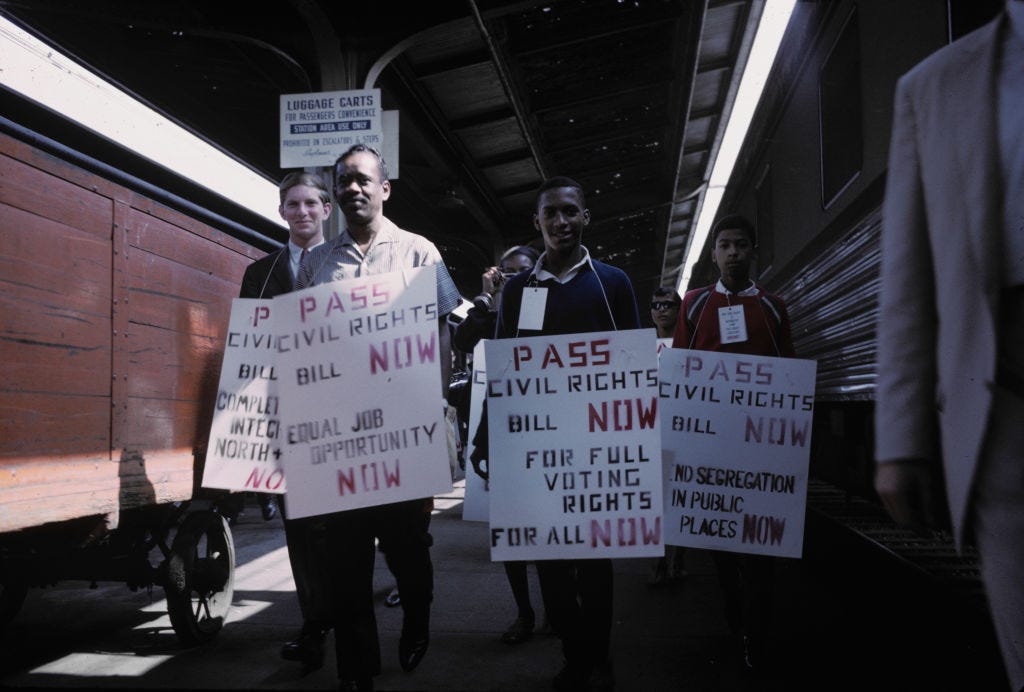
For nearly a century, the Legal Defense Fund (LDF) has been an inextricable part of the voting rights movement. LDF, alongside many allies, has litigated, organized, marched, and advocated for expanded protections for Black voters since its founding in 1940.
This Black History Month, as voting rights continue to take center stage in the national conversation, LDF is looking back at some of the most crucial moments in voting rights over the last 85 years. Much of this history centers around the passage and enforcement of one watershed bill: the Voting Rights Act (VRA) of 1965.
The VRA was one of the Civil Rights Movement’s most significant legislative accomplishments. With VRA’s enactment, our democracy, one that finally allowed everyone equal access to the ballot box, truly began. The VRA ended discriminatory practices like poll taxes, literacy tests, and grandfather clauses that were used to deny Black voters their right to vote. It also established visionary preclearance requirements that, for decades, prevented voting discrimination before it occurred and provided voters across the country with essential tools to fight discriminatory election rules and practices in various forms.
The passage of the Voting Rights Act in 1965 was a much-needed wake-up call for many who ignored the centuries of violence and illegal election practices levied against Black people. Over 60 years later, it remains a critically important law that, unfortunately, has faced severe strain in recent years following multiple Supreme Court decisions that significantly weakened it. These decisions, coupled with an onslaught of regressive federal and state voting laws, demonstrate that the right to vote fairly and freely in the United States is once again under significant threat.
As we navigate this reality during Black History Month, we can look to the past for inspiration and shed light on how our forbearers waged similar battles. Therefore, we’re opening our Archives to take a walk back through history and highlight documents that showcase the unyielding fight to defend and expand Black voters’ rights during the Civil Rights Movement.
1. Smith v. Allwright Case Memo from Thurgood Marshall


In November 1941, LDF’s founder, Thurgood Marshall, sent this memo to his office detailing updates on the case that would eventually become Smith v. Allwright. This Supreme Court case ended the all-white primary system that allowed white politicians to structurally dominate Southern politics. It was a watershed moment in the struggle for Black rights, signaling the beginning of the Second Reconstruction and the modern Civil Rights Movement.
2. Smith v. Allwright Case Argument Letter
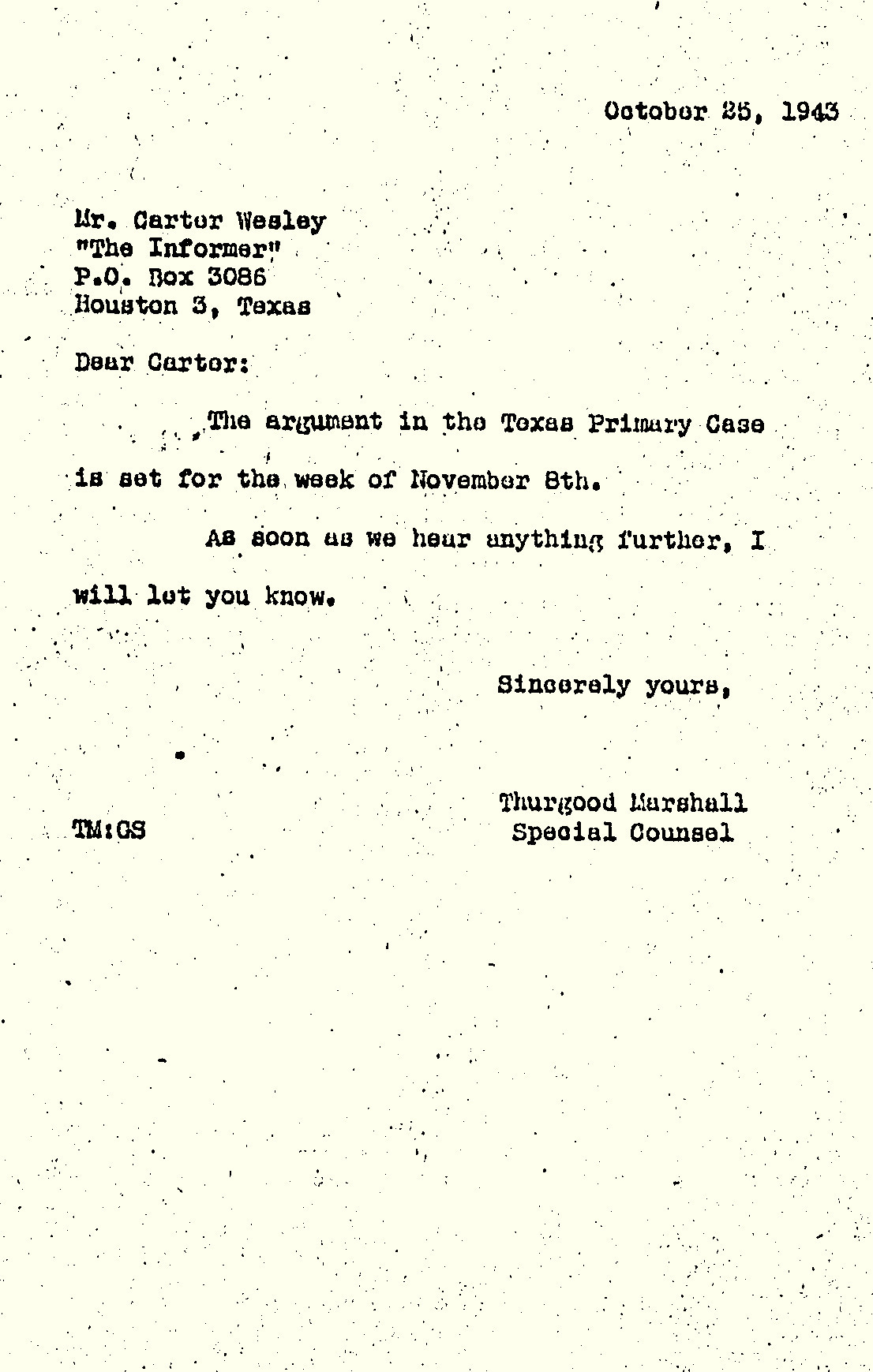
In this brief but important letter, Marshall details the logistics for the oral argument of the Smith v. Allwright case. Marshall was writing to Carter Wesley, a civil rights advocate and partner in the Allwright case.
3. Telegram Following the Death of Lonnie Smith, Plaintiff in Smith v. Allwright
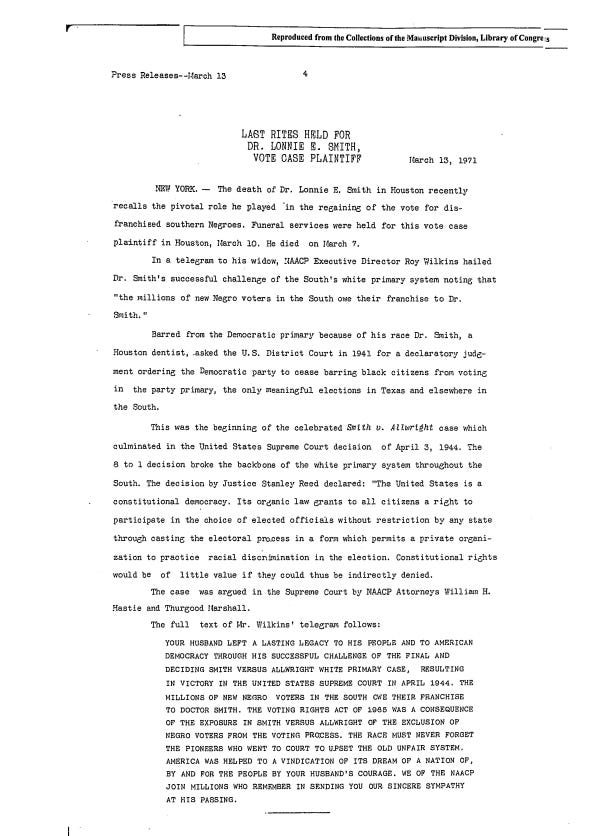
This press release and telegram from LDF’s Archives was sent from then-NAACP Executive Director Roy Wilkins to the widow of Lonnie Smith, named plaintiff in Smith v. Allwright, following his death on March 7, 1971. In the telegram, Wilkins cites the pivotal role of the case, argued by Marshall and William H. Hastie, in raising awareness about the exclusion of Black voters from the voting process. This awareness-raising readily contributed to the passage of the Voting Rights Act of 1965. “America was helped to a vindication of its dream of a nation of, by, and for the people by your husband’s courage,” Wilkins said of Smith.
4. NAACP v. Gadsden County School Board Complaint
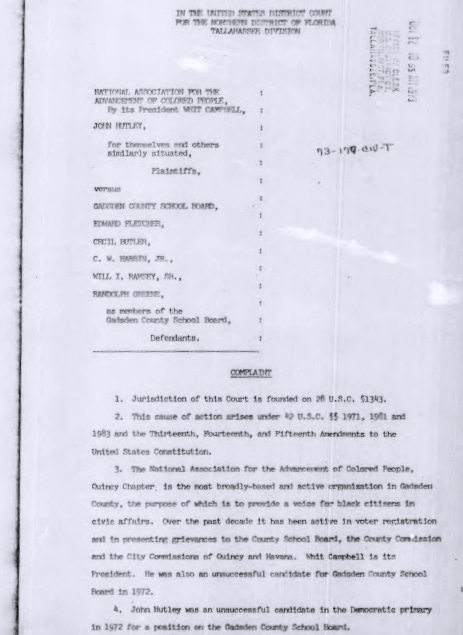
LDF submitted this complaint in the Northern District of Florida in 1973. The complaint argued that the at-large election system for choosing school board members caused racial vote dilution and was unconstitutional. Eventually, upon appeal, the 11th Circuit U.S. Court of Appeals ruled that racial vote dilution was taking place with discriminatory intent, securing a major win in the fight to empower Black communities to elect candidates of their choice.
5. Moore v. City of Pacific Memo
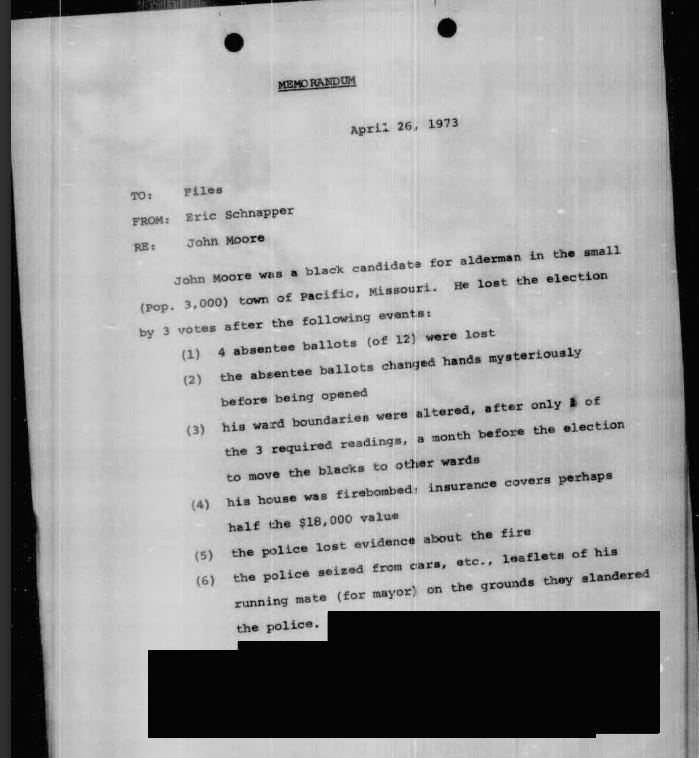
LDF Counsel Eric Schnapper sent this memo in 1973 detailing the events of an election in Pacific, Missouri, that saw a Black candidate unfairly treated in his run for alderman. The case eventually reached the Missouri Court of Appeals. There, LDF demonstrated that before the alderman election, this candidate was unfairly forced to run in a district he was far less likely to win, in an effort to keep a Black candidate out of this position of power. The appeals court agreed and ordered the return of the previous ward district lines.
6. Dove v. Rockefeller Memorandum Opinion
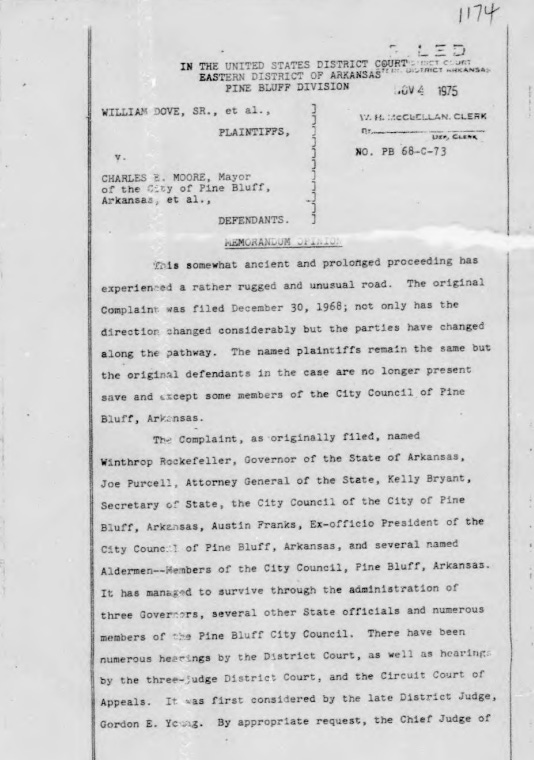
In 1975, this opinion was handed down in the Dove v. Moore case (originally Dove v. Rockefeller), which challenged Pine Bluff, Arkansas’ method of electing all eight members of the city council in at-large races rather than from single-member wards. This case alleged that the at-large system diluted Black voters’ power, denying them the opportunity to elect candidates of their choice to the city council. Ultimately, upon appeal, it was ruled that, despite compelling evidence LDF presented to the contrary, the at-large system was not unconstitutional in this instance.
7. Legal Defense Fund Annual Report, 1981-1982
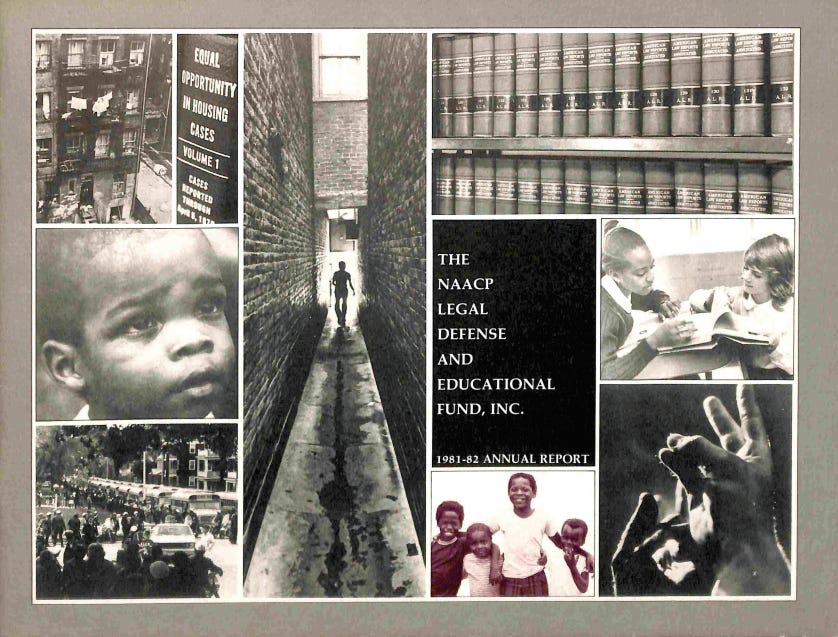
The voting rights portion of LDF’s annual report from 1981-1982 details the role LDF played in defending voting rights for Black voters across the country — challenging discriminatory redistricting practices, standing up to illegal voting practices, and advocating for the extension of the VRA. It also mentions the landmark Gingles case, which LDF would eventually win before the Supreme Court. The case empowered voters of color nationwide by redefining redistricting law when it ruled that North Carolina's at-large election system illegally diluted Black voting strength. This ruling led to the adoption of the Gingles factors, which courts still use today to determine if voting practices violate Section 2 of the Voting Rights Act.
***
LDF has always been committed to ensuring Black voters can fully and freely exercise their fundamental right — and these items from our archives highlight the multifaceted and unyielding nature of this work. We, along with our allies, remain committed to continuing this fight during Black History Month and far beyond to ensure every voter can use their voice to effect positive change in their communities.
To learn more about LDF’s Archives, check out Recollection: A Civil Rights Legal Archive.
 | A guest post by
|